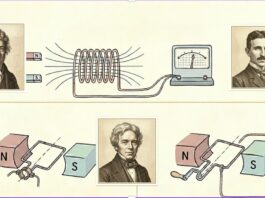
Drama in Three Acts
Introduction
No one really knows how fascinating the story of electric current is.
We know that when we press a switch, the light turns on. We know that when we turn a key, a car starts. But rarely does anyone stop to think: how did humans even discover that tiny electrons can flow through a wire, just like water flows through a pipe? What is even more unbelievable is that it took us more than 2,000 years to make that discovery.
And when we finally succeeded – believe it or not – it happened completely by accident. And the most beautiful part of all: the man who first observed electric current flowing through a frog’s leg did not even know what he had discovered. Just like Christopher Columbus did not know he had discovered a new continent.
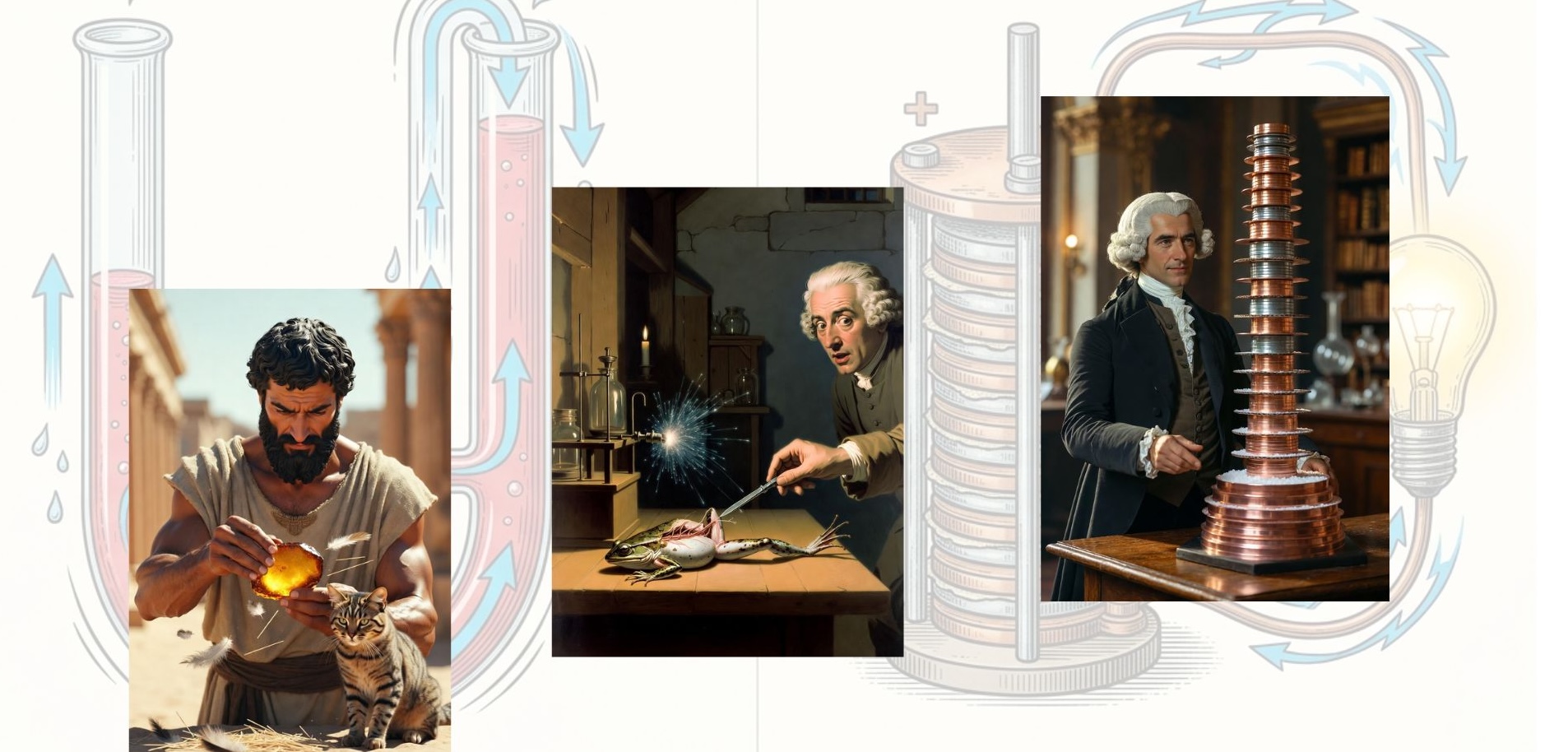
So it all began with one dead frog, one curious professor, and one great conqueror. Without that unusual trio, the world today might look completely different. There would be no light bulbs, phones, computers, the internet, electric cars – and perhaps not even this text you are reading right now. So let us go back more than two thousand years – and meet the people who, step by step, uncovered the secrets of electric current. If they did all that for humanity – the least we can do is read their story.
Act I: Magic from Amber and Wasted Centuries
It all began more than 2,500 years ago in ancient Greece. The philosopher Thales of Miletus noticed a strange phenomenon: when a piece of amber was rubbed with cat fur, it would suddenly “come alive” and start attracting light objects like feathers or straw. And that was where everything stopped.
For centuries, this was considered nothing more than a trick or a kind of magic. People saw that something was happening, but they had no idea about the true nature of electricity. And so humanity wasted almost 2,000 years, not knowing how to harness this invisible force and put it at the service of mankind.
The first real breakthrough came only in the 18th century, when scientists realized that electricity was not magic, but an invisible “fluid” that could even be collected. People began more serious experiments, although they still did not know what was happening at the microscopic level. The first capacitor (the Leyden jar) was invented, and large metal spheres were charged to produce strong sparks.
Humans had learned that electricity could be collected and stored, but still did not know how to make it flow. They had full “glasses” of electricity, but still did not know what to do with it. It remained just an interesting toy for aristocratic salons.
No one suspected what this invisible force could one day become – a force that would completely change the course of history.
Act II: Luigi Galvani and an Unexpected Experiment
If we had to point to the exact moment when humanity moved from magical tricks with amber to the discovery of electric current, we would have to go to 1780, to the Italian city of Bologna. There lived a professor of anatomy named Luigi Galvani.
Galvani was not a physicist. He did not think about wires, electrons, or light bulbs. He was a doctor fascinated by biology and the secrets of the human body.
And just like Columbus searching for gold and spices and stumbling upon a new continent, Galvani was researching nerves and muscles – and discovered electricity.
On his table were dissected frog legs, a copper hook, and an iron railing nearby. A completely ordinary experiment, nothing spectacular. Until his assistant accidentally touched the hook to the iron railing. The frog leg twitched. The dead frog behaved as if it were alive. Galvani believed he had discovered “animal electricity” – a special force found only in living beings.
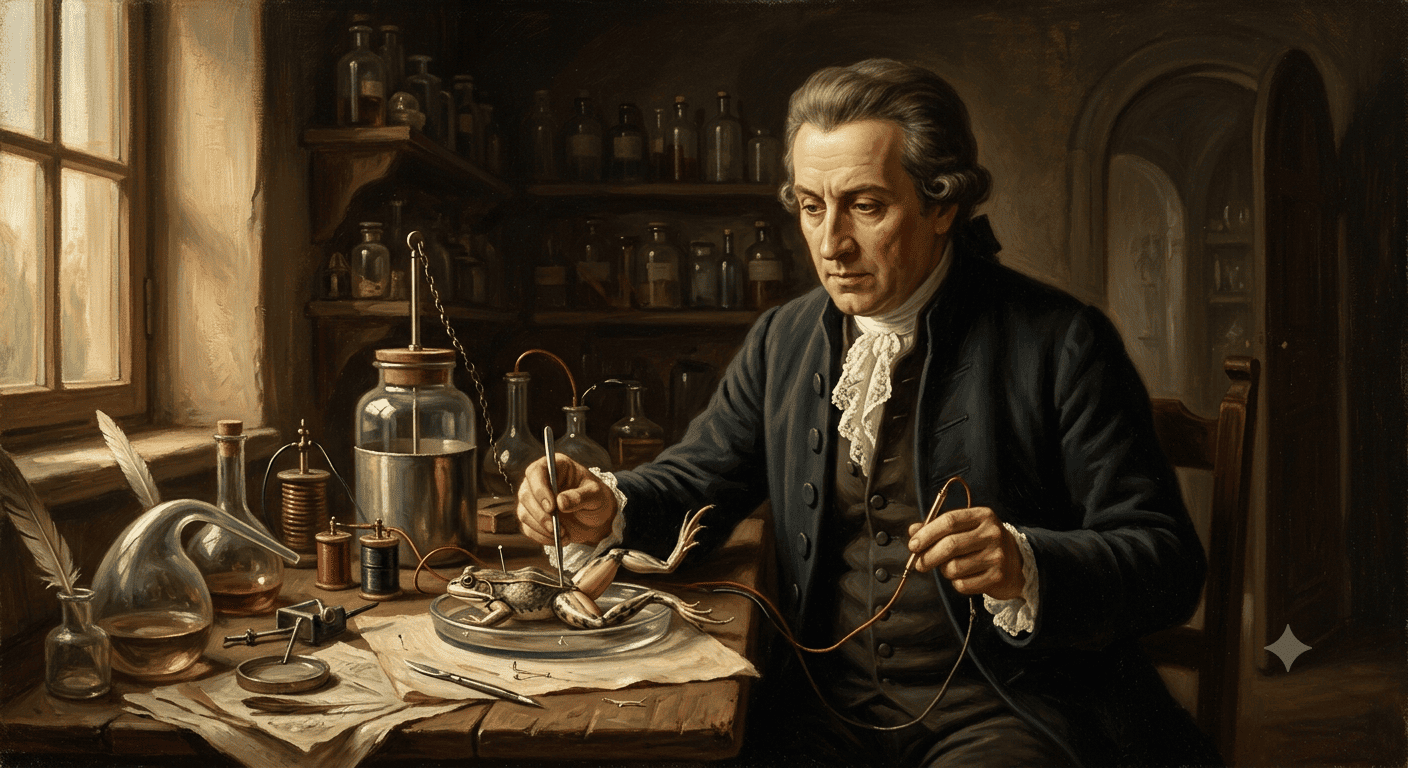
The real cause of the phenomenon was the contact of two different metals, both touching the moist tissue of the frog’s leg. Due to the difference between the metals, an electrical charge separation and a potential difference occur. When the circuit is closed through the tissue, electrons begin to move – and an electric current is created, causing the frog’s leg to twitch.
Transition from Act II to Act III
Thus, an ordinary dead frog sparked a wave of scientific rivalry that, through a fierce debate between Galvani and Volta, would eventually force electrons to flow through a wire like water through a pipe.
But for current to flow, a source was needed.
Just as water needs a spring, a well, or rain to flow, electricity also needed something to continuously drive it. Galvani showed that electrons could be made to move. Volta, however, realized there must be something that pushes that current through a conductor – something that generates and maintains it.
That “something” was the first battery – the Voltaic pile.
And that brings us to the third and final act of this story. Here, the frog leaves the stage, and electric current finally gets its first reliable source. It is no longer a wild force striking from the sky or crackling in amber. It becomes controlled, usable energy – ready to change the world.
Act III: Volta, Napoleon, and the First Battery in the World
While Galvani stubbornly defended his theory of “animal electricity” until his death in 1798, Alessandro Volta worked in silence. He no longer argued. He no longer wrote angry letters. He built.
Galvani showed that electricity exists. Volta wanted to show where it comes from and how to produce it whenever desired.
For two years, he experimented. Instead of frogs, he used metals and liquids. And then, in 1799, he created something revolutionary: the first true battery in the world. This was something the world had never seen before.
What did Volta’s pile look like?
Imagine a tower made of copper and zinc discs stacked alternately, like pancakes. Between each pair of discs was a cloth soaked in saltwater. The entire structure was nearly one and a half meters tall and contained around 600 discs.
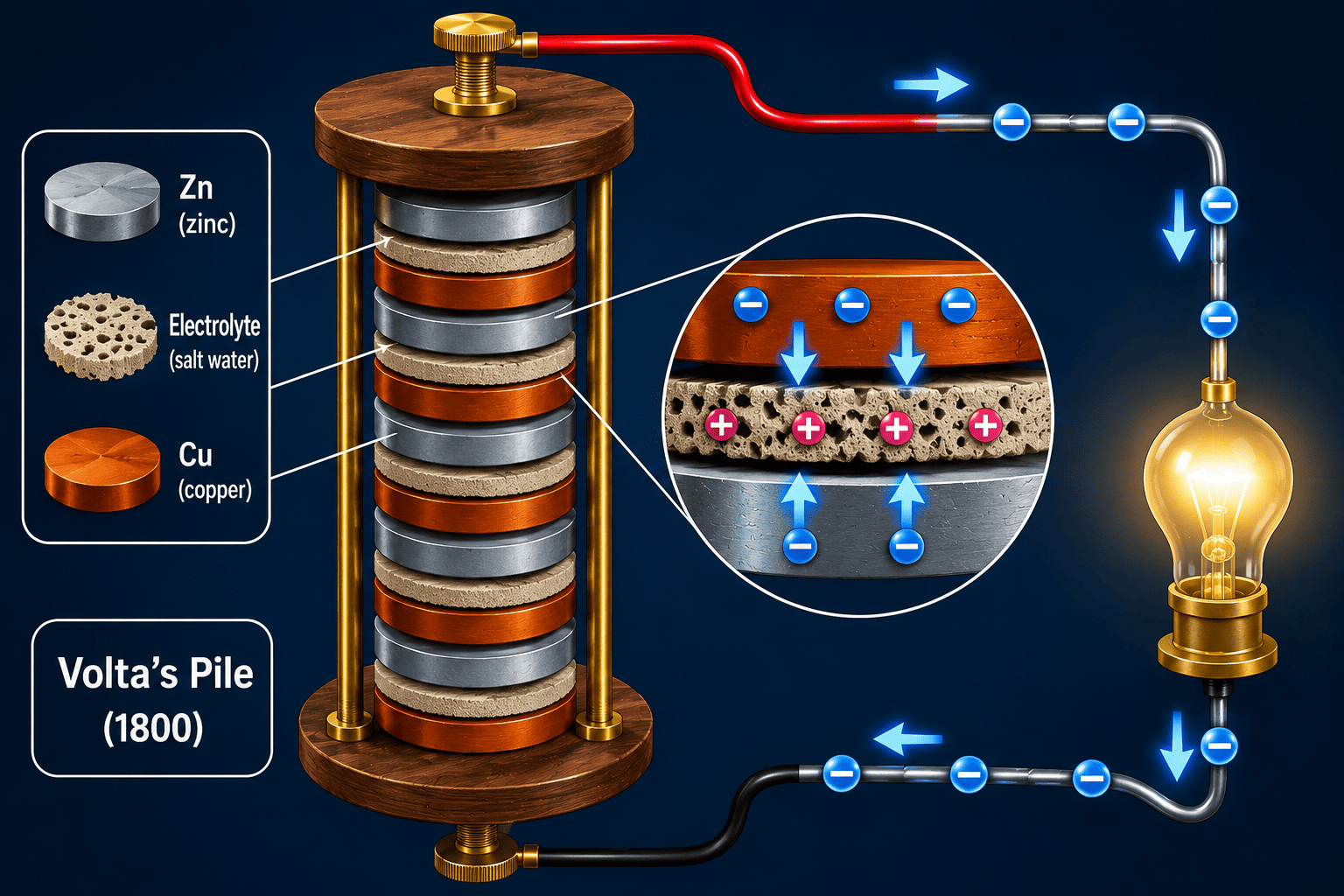
This was the Voltaic pile – the first chemical battery in history.
Unlike earlier experiments that produced only short sparks, Volta’s pile produced a steady, continuous current. When wires were connected, electrons began to flow – and did not stop. It could heat wires, decompose water into hydrogen and oxygen (electrolysis), and much more.
Volta now had a source – something that could push electrons through a wire like a pump pushes water through a pipe.
Volta became extremely famous in Europe. His experiments impressed scientists and politicians, including Napoleon Bonaparte.
Journey to Paris: Before Emperor Napoleon
Volta knew what he had. And he knew who needed to see it.
In 1801, he traveled to Paris, to Napoleon Bonaparte himself. The First Consul, a man reshaping Europe, was not a scientist – but he had an eye for things that change the world.
Volta calmly explained: “Sire, this is my pile. Copper, zinc, and salt water. No frogs. No magic. Pure chemistry.” Then he connected the wires. The room fell silent. And then – a small, bright spark jumped between two metals.
Not just any spark – but a continuous, repeatable, reliable current. Volta could switch it on and off at will. Napoleon was impressed. This was not a toy. This was a tool.
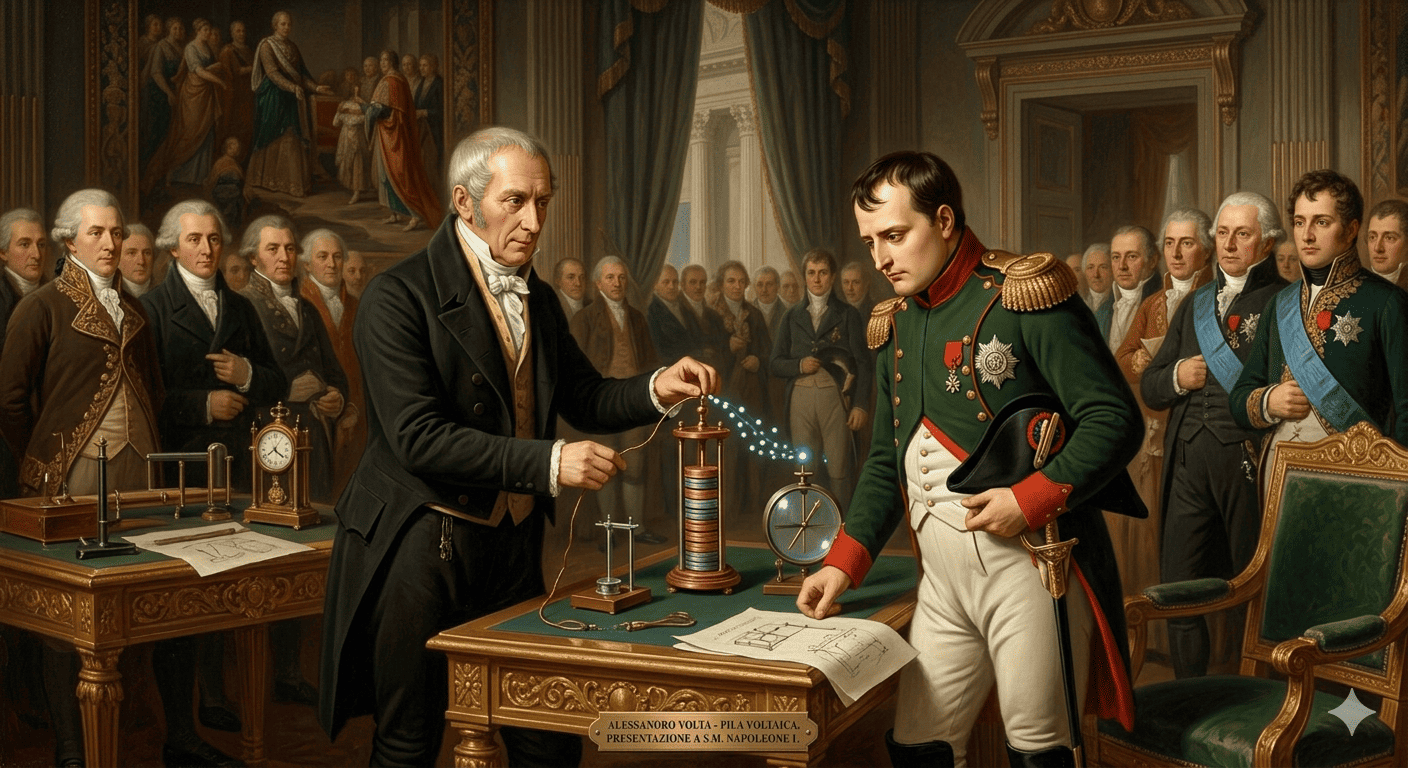
He awarded Volta the Legion of Honour, granted him the title of Count, and established recognition for scientific achievement.
Napoleon later said: “Volta’s battery is the beginning of a new era. I do not fully understand it, but I see its power.”
Victory and the End of Rivalry
Galvani was already dead. His theory of “animal electricity” was finally disproven – but not in a hostile way. Volta never insulted him. He said: “Galvani saw electricity, but did not recognize its true source. I only corrected him.”
And so, a frog, a rivalry, and an emperor led to the first battery.
Today, the unit of electric potential is named after Volta: the volt (V).
And Galvani’s name lives on in words like “galvanization” and “galvanic cell.”
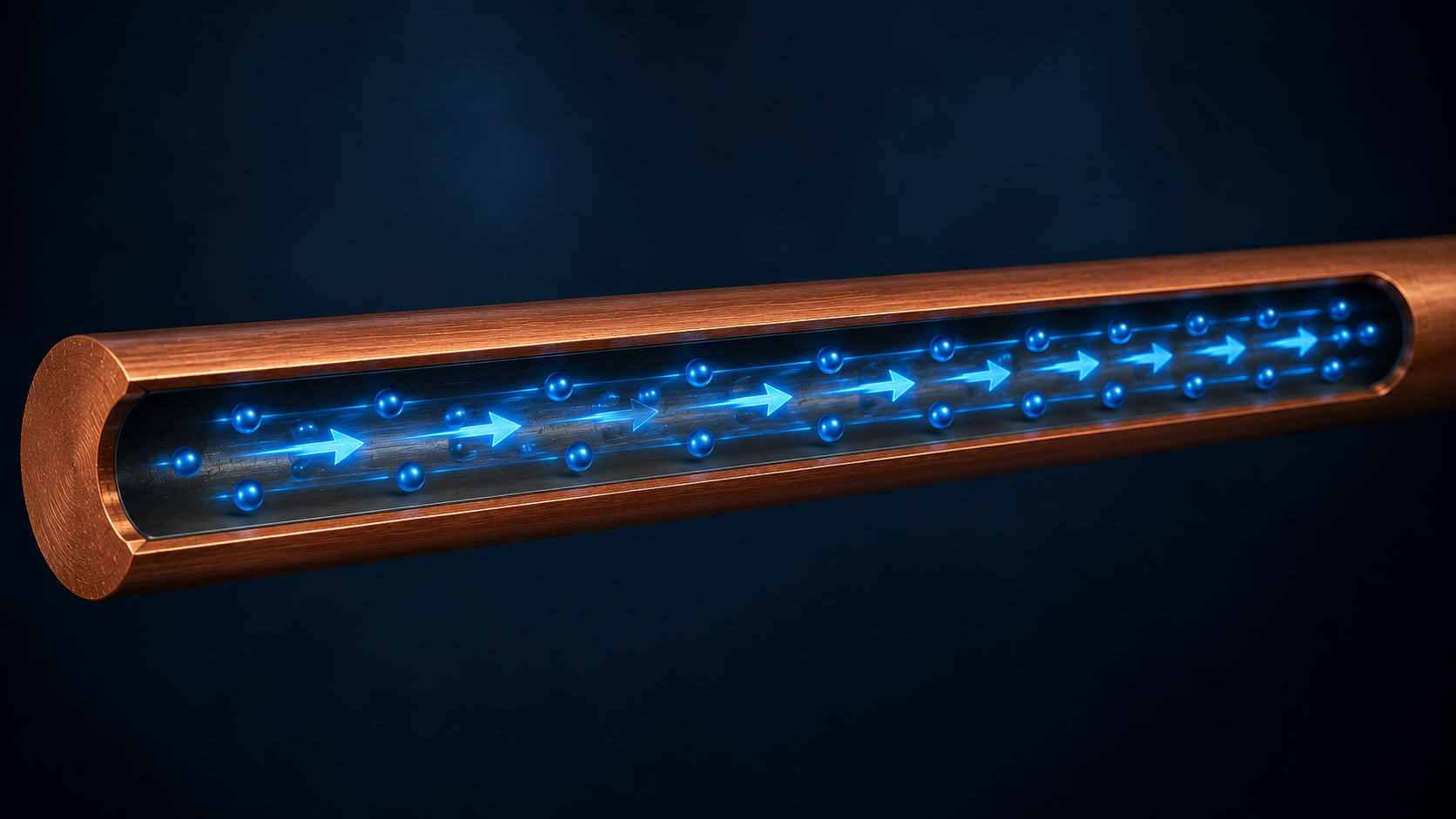
Important Note: At the time of Galvani and Volta, scientists did not yet know that electrons existed, nor did they understand the internal structure of the atom. They often described electricity as a kind of “electrical fluid.” It was only in the late 19th and early 20th centuries that the electron was discovered and models of atomic structure were developed, making it possible to explain electric current as the orderly movement of electrons through a conductor.
Final Note: The Battery as a Water Source
To understand what happens inside Volta’s pile, imagine a U-shaped tube. On one side, water is higher. On the other, lower. Water flows until levels equalize. Then it stops.
Electricity behaves the same way. The difference in water level is voltage (potential difference). The flowing water is electric current. The pipe is the conductor (wire).
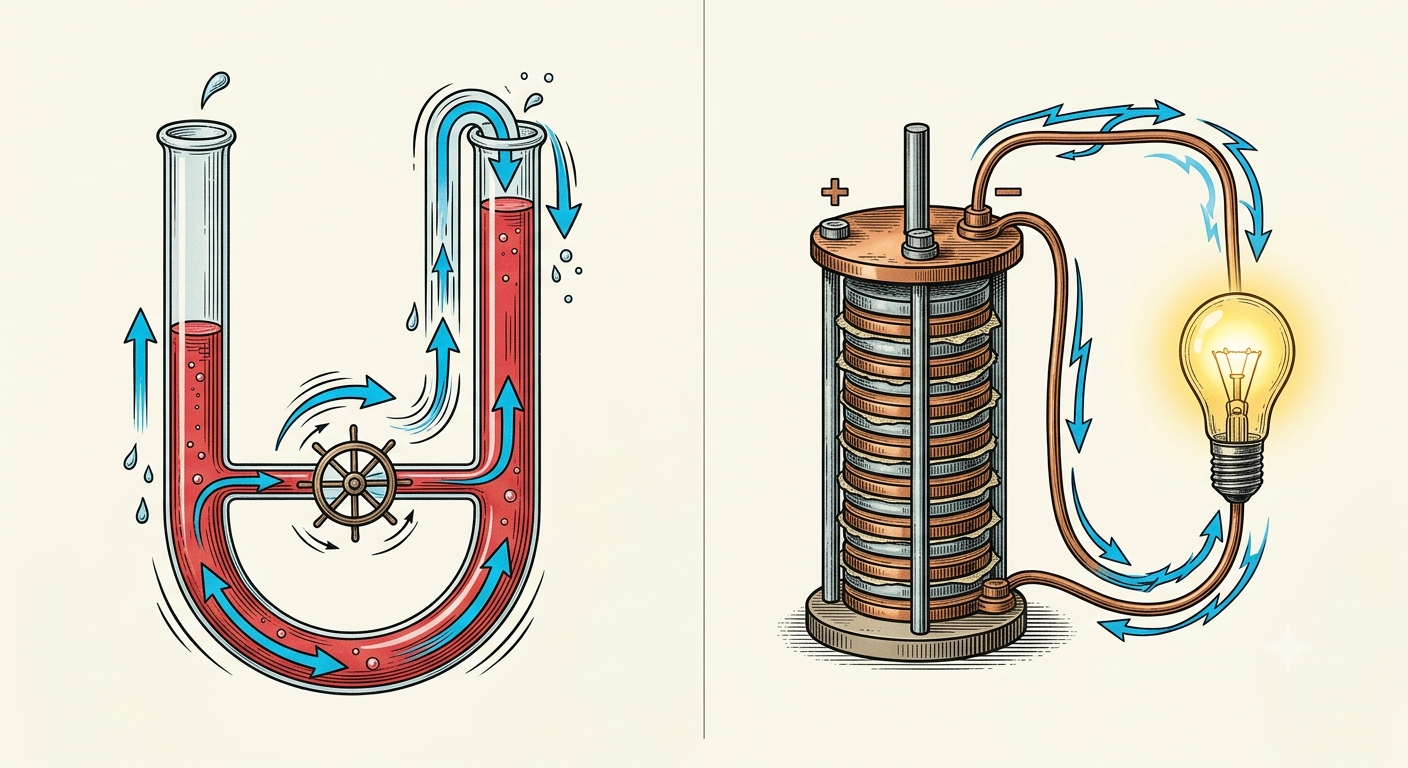
Electrons always move from negative to positive – from excess to deficiency.
They flow until equilibrium is reached. Inside a battery, chemical reactions maintain this imbalance. When the reaction stops, the battery “dies.”
It is not that electricity disappears – the process that created it stops. Chemical energy is converted into electrical energy.
End of Part One. To be continued.