Among all possible forms of prestige in society—whether wealth, social class, or titles—I have always been most fascinated by intellectual aristocracy. At the very top of that aristocracy stand geniuses. They are the true driving force of social processes, visionaries who have led humanity from one era into another.
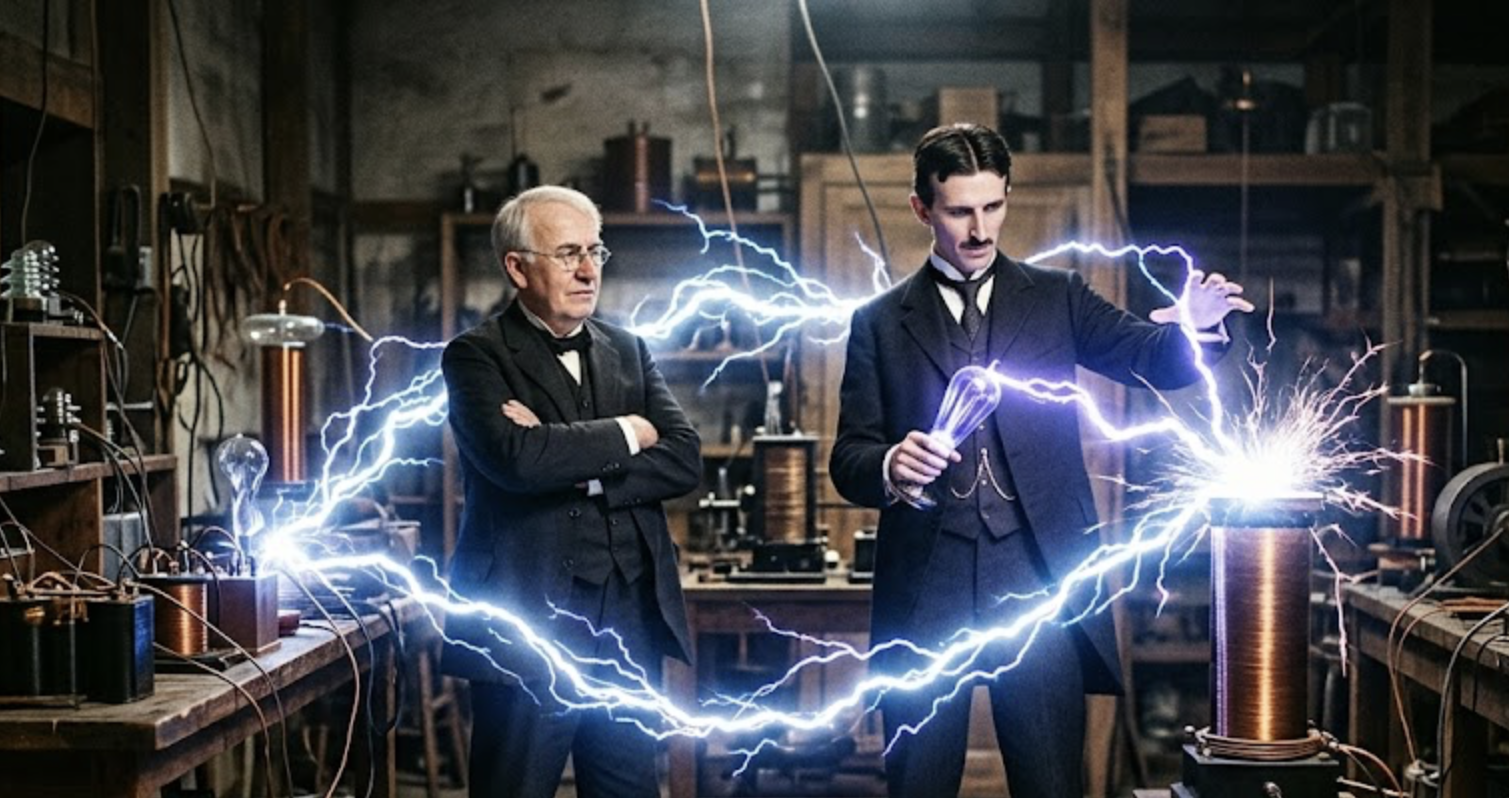
A particularly fascinating story is that of two geniuses who marked an entire epoch and guided humanity into the modern age. Although history has seen many such minds, these two are especially significant because their paths crossed in real time. They were Nikola Tesla and Thomas Edison.
The Historical Encounter and the “American Joke”
Nikola Tesla arrived in America from the Balkans, more precisely from the Military Frontier (today’s Croatia), as an ethnic Serb, carrying only a few coins in his pocket and a precious letter of recommendation for Edison. While waiting in Edison’s office, New York was struggling with constant failures in its electrical systems, and Edison did not have enough engineers to solve these problems. An opportunity arose when a serious malfunction occurred in the electrical system of a ship. Tesla then approached Edison and handed him the letter of recommendation, which read:
“I know two great men—one is you, and the other is this young man I am sending you.”
Edison then offered Tesla a challenge: if he succeeded in repairing the generator and solving the problem, he would receive a reward of 50,000 dollars (a huge sum at the time). Tesla, thanks to his brilliant mind, successfully completed the task. However, when he asked for the promised payment, Edison coldly refused, saying:
“Tesla, that was an American joke.”
Deeply offended by this act of deception, Tesla’s well-known Balkan determination took over. He immediately resigned and ended all cooperation with Edison. He spent the following year digging ditches just to survive, but with a clear vision that he would never again work for a man who did not respect his word or scientific effort.
The War of Currents: A Clash of Two Systems
This personal split soon escalated into the greatest technological conflict of the modern era, historically known as the “War of Currents.” When Tesla joined forces with industrialist George Westinghouse and began promoting his alternating current (AC) system, Edison saw it as a direct threat to his direct current (DC) empire.
It was a ruthless economic and propaganda war. In order to prove that Tesla’s electricity was dangerous, Edison organized public demonstrations in which animals were electrocuted using alternating current. He even went so far as to sponsor the invention of the electric chair to associate Tesla’s system with death in the public mind. However, truth and progress could not be stopped: Tesla’s alternating current triumphed because it could be transmitted over hundreds of kilometers without major losses, while Edison’s direct current could barely power objects more than a kilometer away from a station.
Nikola Tesla: The Man Who Married Science
Both men continued to contribute immensely to civilization, but in completely different ways. Nikola Tesla was a strikingly handsome, tall, and elegant man, yet he consciously chose a life of celibacy. He never married, openly stating that he had “married science” and that family life would distract him from higher goals.
His ultimate scientific triumph in the War of Currents was crowned by the design of the first hydroelectric power plant at Niagara Falls. This definitively proved the superiority and safety of his alternating current compared to Edison’s direct current, which had frequently caused fires in cities.
In addition to AC systems, Tesla gave humanity:
- The induction motor, which still powers modern industry today.
- The Tesla coil (transformer), which enabled high-frequency experiments.
- Radio control, demonstrated through the first remotely operated boat in history.
Tesla was decades ahead of his time. His work with high frequencies opened the door to modern radio technology, and his vision of wireless energy transfer and a global information system was essentially a precursor to today’s internet and smart technology.
Thomas Edison: The Man Who Conquered Darkness and Silence
On the other hand, Thomas Edison had a completely different, difficult, and unconventional life path. As a child, he was expelled from school because he did not fit into the standard education system. His mother, believing in his potential, took over his education. She told him he was special, that he possessed an extraordinary gift, and that he could learn far better on his own than in school. This maternal belief laid the foundation for his later success.
Edison was a tireless practitioner and entrepreneur who, in his youth, did everything and anything. While working on the railroad and publishing newspapers, a fire broke out in a train carriage due to his chemical experiments. According to one of the legends of his life, the conductor slapped him so hard at that moment (or pulled his ear so forcefully) that Edison became partially deaf in one ear for the rest of his life.
Nevertheless, his contribution to humanity is epochal:
He turned darkness into light—although he did not invent the concept itself, he perfected and commercialized the first long-lasting electric light bulb with a carbon filament, which illuminated homes around the world.
He turned silence into sound—by inventing the phonograph (the first gramophone), achieving what at the time seemed like pure magic: the artificial reproduction of human voice and sound.
Today these inventions seem completely natural and obvious, and we often forget what a civilizational leap they represented. Edison was a genius of practicality and organization, a man who turned ideas into reality and industry.
AzizA